
Grant County Deed Types
A deed records a stated transfer of a real-property interest. The Grant County Recorder keeps deeds as permanent public records under IC 36-2-11-8. Every instrument names its parties, holds a legal description, and bears a recording reference. Wording matters here, because different deeds carry different promises about what the grantor actually conveyed. The Recorder also indexes mortgages, releases, powers of attorney, real-estate contracts, final decrees, surveys, liens, plats, condominium filings, and cemetery deeds. Many of these touch a parcel without transferring it.
| Deed Type | What It Does | Common Use |
|---|---|---|
| Warranty deed | Conveys the stated interest with title promises written into the instrument | An ordinary purchase and sale |
| Quitclaim deed | Conveys whatever interest the grantor has without promising that interest is valid | Family transfers or correcting a title issue |
| Trustee or fiduciary deed | Transfers property through an authorized trustee or estate representative | Trust and estate administration |
| Sheriff's deed | Documents a transfer following a court-directed sale | Foreclosure proceedings |
| Tax deed | Documents the interest issued after the statutory tax-sale process | Delinquent-tax property |
A mortgage or lien is an encumbrance rather than a deed. It can burden an owner's interest without changing the owner of record. A release may later show that claim was satisfied. Read the document type, parties, dates, and legal description together. Not every Recorder hit marks an ownership transfer.
Search Grant County Deeds Online
Fidlar Tapestry serves as Grant County's on-demand remote index for occasional deed searches. It charges per search by credit card. It requires no user agreement. Images can be viewed at no added cost. Printing costs extra. Frequent users can ask the Recorder about Laredo, the subscription option. Neither ePrepare nor Simplifile is a public research index; both simply submit documents for recording.
Tapestry supports searches by party and by property clues. A narrow date range plus a known party name keeps a paid query focused. Search business, estate, and trust names as indexed entities. Apostrophes may call for the percent-sign convention described in the official guide.
The live Tapestry entry screen opens the remote doorway into Grant County deed records.

Use the county selection and index controls to reach recorded documents, then save each citation before paying for another query.
| Index field | Input | Useful detail |
|---|---|---|
| Grantor / Grantee | Last, first, middle name or business name | Use variants, initials, and the business-name field convention |
| Recorded date | From and through dates | Narrows a conveyance or release period |
| Document | Instrument number or type | Best when a prior citation is known |
| Subdivision | Exact subdivision, then lot and block | Subdivision must match the county entry |
| Parcel / legal clues | Parcel, book/page, or metes and bounds | Separates similar party names and tracts |
Record the document number, recording date, deed type, parties, consideration when shown, and the book/page reference. Those fields become the audit trail for your next property records search. Note: Tapestry charges per query, so refine the name, date, subdivision, or parcel clue before submitting again.
Grant County Deed Grantor Chain
The grantor-grantee index is built around the people at each recording event. Start with the latest known owner from the Grant County property search. Find that party as grantee on the acquisition deed. The deed's grantor then supplies the prior owner's name. Repeat that move to build a chain backward. Use the legal description to keep every step tied to the same parcel.
- Find the latest acquisition deed with the present owner shown as grantee. Verify the parcel or legal description.
- Read the grantor's name from that deed. Record the instrument number, date, book/page, and deed type.
- Search that grantor as an earlier grantee. Compare the legal description before accepting the match.
- Repeat until the remote index stops producing reliable results, then shift to deed-book and microfilm indexes.
- Grantor
- The party transferring the stated interest.
- Grantee
- The party receiving the stated interest.
- Chain of title
- The linked sequence of recorded transfers for the same land.
- Book/page
- A volume-and-page citation used for a recorded instrument.
- Instrument number
- A unique recording identifier that can retrieve a document directly.
Names alone make weak matches. Compare lot and block, township, acreage, metes and bounds, parcel references, and adjoining-land clues. A married name, middle initial, or entity suffix may shift between instruments.
Grant County Deed Index Origins
The recorder's remote index stays quiet about how far back it reaches. The Indiana State Library microfilm guide fills in that history, documenting general and township deed indexes that reach into the county's 1831 and 1832 beginnings. General runs cover 1831-1889, 1888-1897, and 1895-1901, while township series extend into the 1920s for Center, Green, Fairmount, Franklin, and Jefferson townships.
Those overlapping ranges are both a help and a caution. Search more than one index run when a deed seems absent. Early ownership can also lead into Cass, Delaware, Madison, or federal land material, since Grant County was formed from those counties in 1831. No official source supports a courthouse-fire story or a destroyed deed decade.
Historic depth. The archival catalog proves 1831/1832-era index material exists, but it does not claim those early images are available in Tapestry.
Plats and Easements in Grant Deeds
Many land questions need more than a conveyance deed. Recorded plats define subdivision lots. Surveys, easements, annexations, condominium filings, final decrees, and powers of attorney can explain the shape behind a transfer. Some shed light on the authority behind it. The Recorder FAQ confirms that these records sit in the same permanent-record system.
For platted land, enter the exact subdivision name before lot and block in Tapestry. Rural tracts may rely on section-township-range descriptions. Others use metes and bounds, a boundary spelled out through courses and distances. The Auditor keeps subdivision, street-name, split, combination, aerial-plat, and certified-map support. Gas City adds a precise local rule. A signed final plat must be recorded with the Grant County Recorder within 30 days. Planning approval, county recording, and the later parcel card are related records. They are not substitutes for one another.
Grant Deed Recording Standards
Indiana sets firm standards before a deed can be recorded. Names under signatures must be typed or printed exactly as signed. Every real-estate instrument must also identify its preparer. Beyond that, a deed transfer for taxation needs the Auditor's endorsement. Notarial details must include the county of residence and the commission expiration. Documents prepared and processed in Indiana carry an affirmation. That affirmation states reasonable care was taken to redact Social Security numbers unless law requires them. That rule shields sensitive data. It does not authorize republication of what appears in Grant County property records. Check the Recorder's fee schedule and requirements again before submission. Acceptance and indexing are separate from whether the deed accomplishes its intended legal result.
Note: Recording places an instrument in the public chain. It does not cure weak wording, missing authority, or an incorrect legal description.
When Grant Deeds Need Court Files
Some transfers come out of court proceedings. Probate, partition, foreclosure, quiet-title, and tax-sale cases can all end in a deed. Search Indiana MyCase for a public docket. Then request permitted official copies from the Grant County Clerk. A docket event shows that something occurred in a case. It does not replace the signed order or the deed later filed with the Recorder.
Each office plays its own part. The Auditor handles the transfer endorsement and parcel changes. The Clerk supplies certified court material. The Recorder holds the recorded land instrument. Match the case number, deed parties, legal description, and recording date before relying on anything. That discipline keeps a court case involving one tract from being attached to another.
Order a Grant County Deed
Copies of Grant County deed records come two ways. You can view an available Tapestry image remotely. You can also request a plain or certified copy from the Recorder. The published schedule lists copies up to 11 by 17 inches at $1 per page. Larger copies run $5 per page, and certification is $5. For in-person service, the Recorder sits on the third floor at 401 S. Adams Street, Marion, open 8 a.m. to 4 p.m. Monday through Friday. Phone service is available at (765) 668-6559. A mail request should identify the instrument. It should also state whether certification is required. Confirm cost and accepted payment before sending it. The official Recorder access hub is the best place to confirm current contact details. It also carries the latest copy instructions.
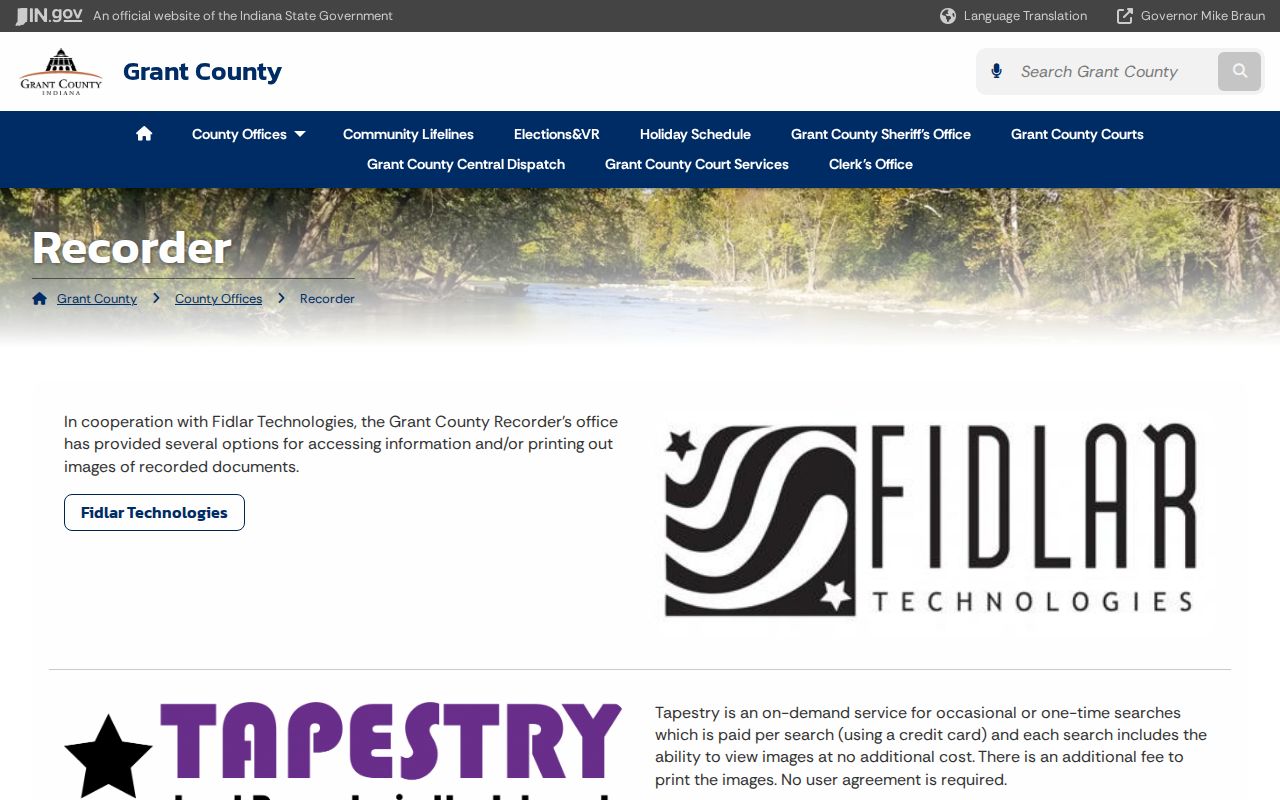
The office page also distinguishes Tapestry, Laredo, electronic submission, and direct Recorder assistance. Start there when deciding how to order.
The office counter is the fallback when a remote search fails. It also helps when an image is missing or the index does not reach the needed period. For older Grant County deed records, carry the book/page or microfilm citation from the State Library guide. A precise reference beats a broad request for every deed tied to a common surname. Email or phone contact can clarify the needed citation, current payment method, and delivery procedure before a mail request goes out. Keep plain-copy and certified-copy purposes distinct. A readable image may serve research. However, a transaction or court matter may call for the Recorder's certification. For recurring remote work, ask the office about Laredo. That route can cost less than paying for many broad Tapestry searches.
Recorded, not guaranteed. Grant County deed records show what reached the public record. Unrecorded interests may exist, and only qualified title review can assess clear title.