
Fields Inside Grant County Property Tax Records
A property tax lookup in Grant County touches three offices. The Assessor sets the gross assessed value and tracks property characteristics. Transfers, deductions, exemptions, tax duplicates, and certified maps belong to the Auditor. The Treasurer keeps the tax account, its installments, and the current payment status. Tie everything together with the parcel number. Owner names and mailing addresses shift over time. So the parcel is the reliable key.
| Tax record field | What the field tells you | Official source |
|---|---|---|
| Land, improvement, and total value | The assessment components used before deductions and rates are applied | Grant County Assessor and Elevate |
| Value history | Year-to-year assessed figures, updated on the annual March 1 cycle | Assessor property card |
| Deductions and exemptions | Relief that may reduce gross value to a taxable or net figure | Grant County Auditor |
| District and account keys | Taxing district, 18-digit parcel number, and 10-digit property number | Grant County Tax List |
| Tax year and bill status | The selected year's account, installments, balance, and payment context | Grant County Treasurer |
Indiana assesses at a 100% level. An individual assessment will not necessarily match a later sale, though. DLGF describes the standard as market value-in-use. That means the value tied to how the property is currently used. From there, the tax bill folds in deductions, tax districts, and the payable-year relationship. A recorded deed is useful evidence. It still does not replace the assessment or the tax bill itself.
How Grant County Property Tax Value Is Set
Indiana gives the Grant County Assessor three ways to pin down market value-in-use. One compares recent sales. One measures income potential. One tallies replacement cost. On top of that, the state demands annual trending. Old assessments get adjusted as the market moves. Every four years Grant County runs a cyclical reassessment. Staff physically inspect about a quarter of the parcels each year. An inspection can fix the property record itself. It corrects age, grade, condition, area, or improvement details that feed the value.
Timing matters too. Sales from 2008 forward are refreshed weekly. Assessed values and value history only roll over once a year. The cycle runs from March 1 to March 1. So a deed can show up in the sales data long before the value catches up. Neither figure alone tells you what a buyer would pay in today's open market.
Check the Assessor's official value and update-cycle page before lining up assessment years side by side.
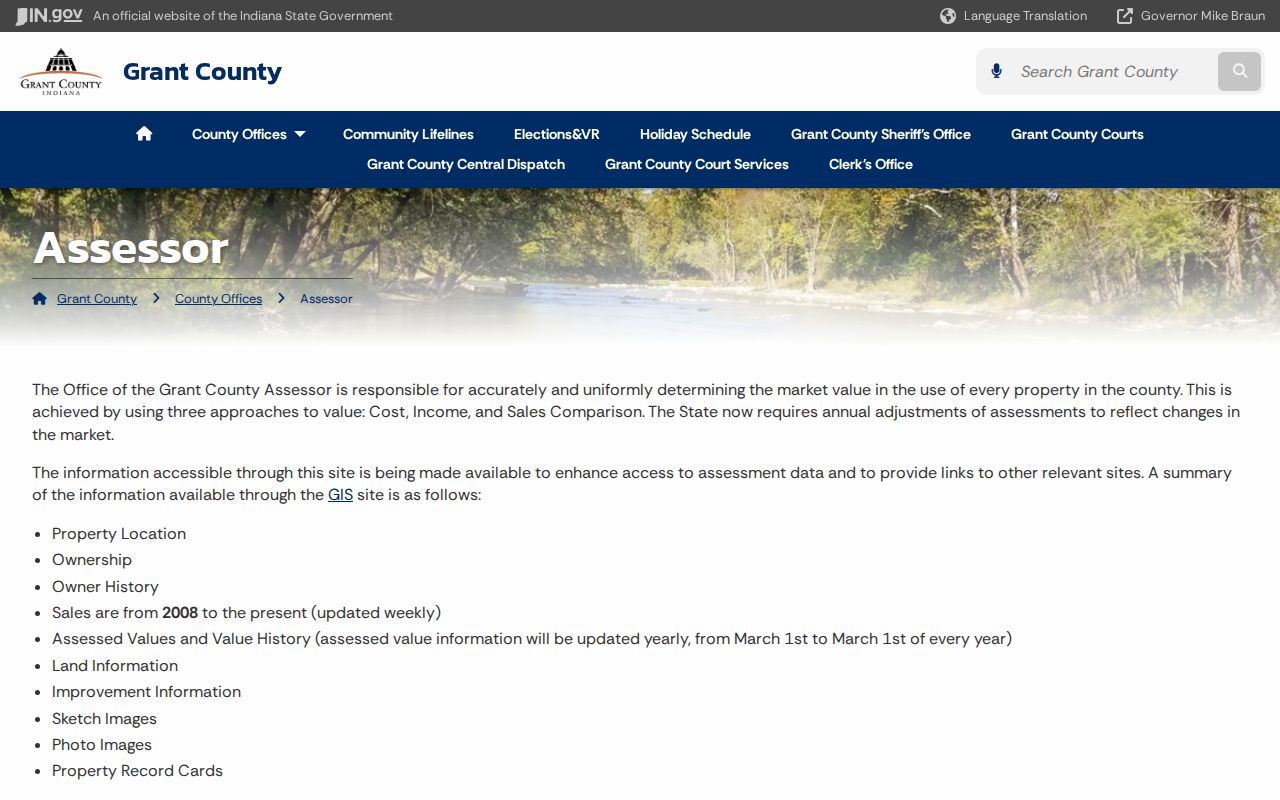
The Assessor's official page documents its assessment methods and the available parcel-card categories. Use the live property card for the current land, improvement, total, and history figures on your parcel.
- Assessed value
- The county's value for the assessment system, usually separated into land and improvements.
- Market value-in-use
- Indiana's true-tax-value concept for the property's current use, not a guaranteed sale price.
- Levy or rate
- The tax charge applied through the property's taxing districts after the assessment process.
- Homestead deduction
- One form of owner-related relief administered through the Auditor under current eligibility rules.
- Tax lien
- A claim tied to unpaid property tax, which requires current Treasurer and sale-status confirmation.
Note: The assessment year normally precedes the tax-payable year, so match the year labels before comparing a notice, property card, and bill.
Find Grant County Property Tax by Its Best Key
Start in Grant County Elevate when all you have is a street address. Confirm the parcel shape and its Property Location, then copy the parcel number. Next, open the Treasurer's Tax List to reach the account. The 18-digit parcel number is a safer match than any name. So is the 10-digit property or duplicate number.
- Locate the physical parcel in Elevate and record the Property Location and APN.
- Enter the parcel or property number in the Tax List; hyphens and periods are optional, but extra spaces are not.
- Select the current tax year, open the matching row, and read its bill or balance information.
- Compare the Assessor value and Auditor deductions with the tax account before drawing a conclusion.
- Contact the Treasurer for current status when a payment, delinquency, or sale deadline is material.
A name search accepts partial forms such as Bill, William, or Wm, plus variants like McCoy and Mc Coy. That flexibility also drags in unrelated taxpayers. Resolve every row back to the parcel. The Treasurer no longer runs parcel searches or takes tax payments by phone, so the public Tax List, a mailed request, or the office counter forms the fallback chain.
Grant County Property Tax List Controls
The county Tax List is the main search form for Grant County property tax records. It keeps the tax account separate from the physical parcel card. Its own labels show why a direct parcel key beats a loose address search.
| Tax List control | Input | Grant County search note |
|---|---|---|
| Dist# | Text or number | Optional taxing-district filter |
| Property/Parcel # | Text | Accepts the 18-digit parcel or 10-digit property number |
| Name | Text | Partial names and spelling variants may broaden results |
| Tax Year | Dropdown | Choose the relevant year and favor current-year status |
| Property Address | Text | May reflect a tax-statement mailing address rather than situs |
Each result row lists district, parcel number, property number, name, and property address. Opening the row reveals more account detail. Save both numeric keys. They are not interchangeable. Personal-property numbering before payable 2009 lacked the county's 27 prefix, which later numbers added. Open Grant County's LowTaxInfo tax-record route to check the current public interface and year selection.
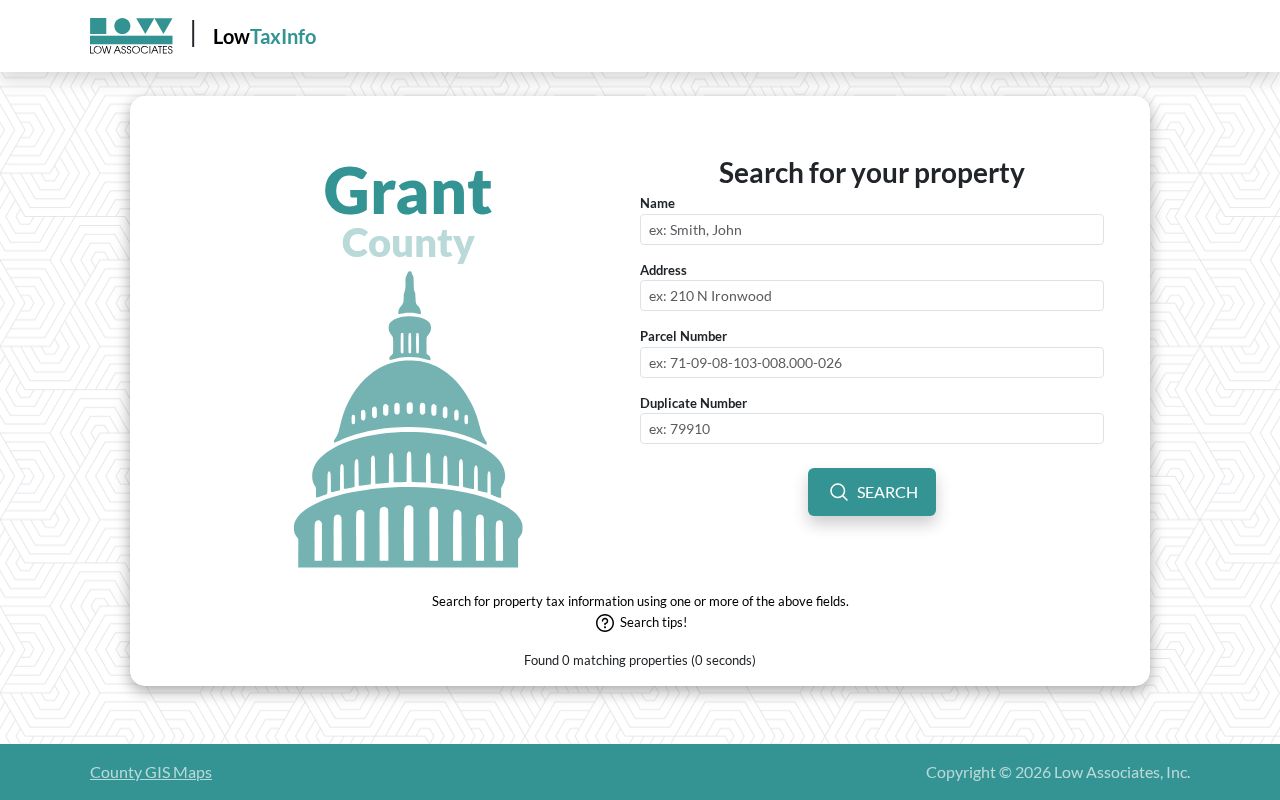
The county's landing page points to its official tax-search destination. Match any result to the APN, and confirm current payment status with the Treasurer rather than a saved image.
Why a Grant County Property Tax Address Can Mislead
A mailing address is not a location. The Treasurer's FAQ says the Property Address on a tax account may simply be where the statement gets mailed. It can even be a former owner's old address lingering in the tax history. Situs questions belong to the GIS and the Assessor's Property Location. Balance questions belong to the Treasurer.
Address changes fall to the Grant County Auditor. That office also processes ownership transfers, splits, combinations, and tax duplicates. It cautions that an address change can disturb Homestead treatment. Bring the parcel number. Ask about the current procedure rather than trusting a mailing line to move the legal location.
Note: A Marion postal name or ZIP does not settle municipal jurisdiction, so confirm the parcel in GIS and use its legal description.
The 2026 Grant County Property Tax Calendar
The Treasurer's page sets the 2026 rhythm. Bills were mailed by April 15. The spring installment came due May 11. The fall installment follows on November 10. Treat these dates as one year's schedule, nothing more, because Grant County warns that prior-year pages stay historical and never reflect current status. For any other tax year, the current-year page on the Treasurer's site is the place to check fresh dates.
| 2026 event | Published date | What to preserve |
|---|---|---|
| Bill mailing | April 15 | Envelope, coupons, parcel and duplicate numbers |
| Spring installment | May 11 | Payment receipt and current account screen |
| Fall installment | November 10 | Receipt and confirmation that the balance posted |
InvoiceCloud handles the paying side of Grant County property tax records: payment history, reminders, paperless statements, and Pay-by-Text. Autopay is included too. It processes money. It does not replace the public record search. Card payments carry a 2.95% fee. The minimum is $1.95, ACH runs $1.95, and a phone payment adds $0.95. For a mailed receipt, send a self-addressed stamped envelope with the bottom coupon.
Grant County Property Tax Deductions Start with the Auditor
Deductions begin at the Auditor, not the Treasurer. That office keeps the forms and records for homestead, mortgage indebtedness, age 65 and over, blindness or disability, veterans, rehabilitated residential property, and qualifying solar, wind, hydroelectric, or geothermal systems. Eligibility turns on the current form and the facts. A deduction label inside old property tax records proves nothing about today.
The Auditor's official deduction forms are the right starting point, paired with the parcel number. The same office holds real, personal, mobile-home, drainage, and special-assessment duplicates. So when a deduction or duplicate question stumps the Treasurer's payment screen, the Auditor's deed records and rolls are where the answer usually sits.
Contest Grant County Property Tax Value on the Current Notice
An appeal attacks the assessment itself. A high bill alone is not grounds. The Assessor's page reported Form 11 notices mailed April 28 to non-exempt parcels, with a June 15, 2025 deadline. The official appeal fact sheet also lays out 45-day and June 15 rules that shift depending on the assessment year and whether a Form 11 went out. Read the date on the current notice. Then verify it with the Assessor before filing anything.
- Review the property card for factual errors in land, improvements, age, grade, condition, or area.
- File a separate Form 130 for each parcel within the deadline that applies to the current notice.
- Prepare sales disclosures, comparable sales, offers, photographs, or an appraisal if useful; an appraisal is not required.
- Take part in the informal Assessor meeting and evidence exchange before the PTABOA hearing.
- If needed after the local decision, follow the current Form 131 route to the Indiana Board of Tax Review.
Protect the deadline. Grant County appeal timing changes with the notice and assessment year, so confirm the live deadline before filing Form 130.
Delinquent Grant County Property Tax Needs a Live Check
An old Tax List page cannot prove a parcel is still delinquent. It also cannot prove the parcel is still eligible for sale. The Grant County tax-sale page covers eligibility, registration, removal payments, and redemption contacts. The Treasurer's notice also flags a 2025 Commissioner's Certificate Sale set for October 2026. Its list changes daily.
Save the date whenever you download a sale list. Then confirm removal or redemption with the Treasurer and Auditor directly. A sale entry is not a deed. A completed sale may still require Recorder instruments. It may also require a court order. This live-status habit matters. Grant County property tax research works best when source dates sit beside parcel identifiers.
Note: A changing sale list is only a lead. An undated download can never show that a parcel is still available.
Get Grant County Tax Records When the Portal Fails
The portal is one channel, not the only one. The Treasurer sits at 401 S. Adams Street, Suite 229, Marion, open 8 a.m. to 4 p.m. Monday through Friday. Ask at the counter or by mail about a current tax bill. You can also use the office's published contact routes for a payment question. The office will not run parcel searches by phone. Upstairs, duties split by floor. The Assessor, on the fifth floor, takes property-card and value questions. The Auditor, on the second, handles duplicates and deductions.
When a public record simply is not online, Indiana's Access to Public Records Act, IC 5-14-3 backs a narrow inspection or copy request aimed at the actual custodian. Name the parcel, the record type, the date range, and the format you want. APRA does not force the county to answer questions or build a custom compilation. Copy charges may follow an adopted fee schedule.