
Compare Grant County Property Value Types
The Grant County Elevate parcel card supplies value history plus sales context for each parcel. Read every label and effective date before comparing figures from it.
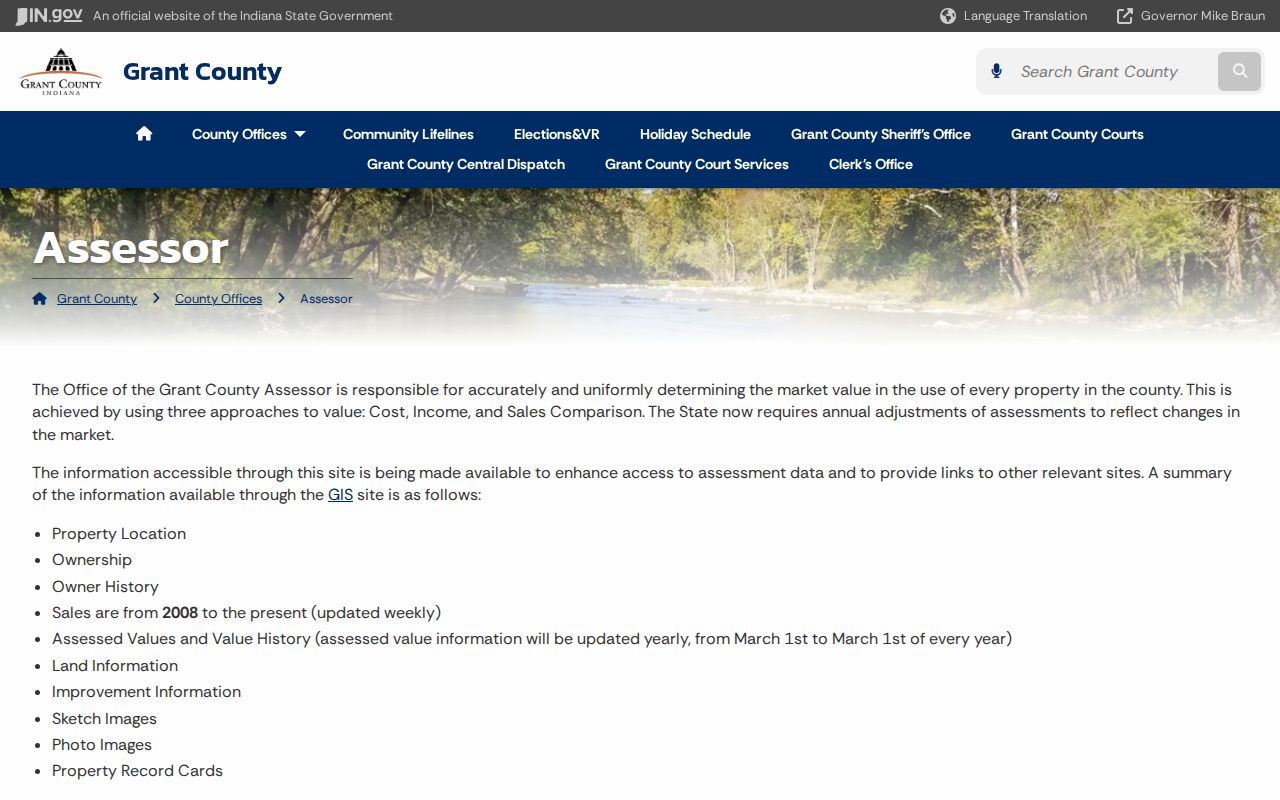
Grant County's official Assessor data pairs assessed value with value history. Each figure makes sense only when read with its date.
| Value | What It Is | Where |
|---|---|---|
| Assessed value | Indiana market value-in-use assigned for assessment | Assessor card and history |
| Market value-in-use | True tax value for the property's current use | Assessment methods and notice |
| Last sale price | Transaction evidence, not always an arm's-length indicator | Sales history and deed |
| Land vs improvement | Separate components behind the total where shown | Assessor information groups |
Indiana's assessment-level target is 100 percent. That statewide standard does not promise one assessed value will equal a future sale price for a Grant County parcel.
Grant County Uses Three Value Approaches
The Grant County Assessor identifies three approaches to market value-in-use: cost, income, and sales comparison. Cost weighs the land and improvement model. Income works when the property's use produces relevant income evidence. Sales comparison turns to suitable transactions. During cyclical reassessment, county and township assessors physically inspect roughly a quarter of parcels each year across four years. This corrects characteristics along the way.
- Assessed value
- The value placed on the assessment roll.
- Market value-in-use
- Indiana true tax value for current use.
- Assessment ratio
- The relationship evaluated through state ratio standards.
- Reassessment
- Review of property facts and value.
Grant County Sales Refresh Faster Than Values
The Assessor reports that sales from 2008 forward update weekly. Assessed Values and Value History refresh yearly. That cycle runs from March 1 to March 1. A recent transaction can therefore appear before the annual value changes. Preserve the as-of date. A sale amount is one transaction datum. Family transfers, fiduciary deeds, partial interests, and non-arm's-length deals may not support a market comparison. Check the Recorder's Tapestry instrument before relying on the number.
Look Up a Grant County Assessed Value
Begin with the physical parcel. A mailing address or a namesake property can otherwise supply the wrong Grant County property value entirely.
- Locate the address or parcel in Elevate.
- Confirm the APN and Property Location.
- Open Assessed Values and Value History, then inspect Land and Improvement Information.
- Read sales as separate transaction context and record each effective date.
- Assessed value
- The value placed on the assessment roll.
- Market value-in-use
- Indiana's true tax value for the property's current use.
- Level of assessment
- The relationship evaluated through state ratio standards.
Land and Improvements Explain Grant County Value
The published GIS inventory separates Land Information from Improvement Information. Sketches, photos, and property record cards appear there too. These groups can show whether a change stems from the site. It could instead come from a building. Or the cause may be corrected characteristics. The Assessor helps in person, by phone, and by email. Visit 401 S. Adams Street, fifth floor, Marion, weekdays from 8 a.m. to 4 p.m. Call (765) 668-4773 or email assessor@grantcounty.in.gov.
Marion Projects Are Context, Not Value Proof
Marion's 2025 infrastructure, Riverfront District, parks, and City Connect announcements can point to permits. They can also signal zoning or changed site conditions. That is context, not proof. It does not show that a specific Grant County property value rose or fell. Tie every conclusion to dated assessment and suitable sales evidence.
What Grant County Property Value Does Not Prove
An assessed value does not guarantee a sale price. It cannot replace an inspection or appraisal. It will not reveal every condition issue, and its effective date, current-use assumptions, physical facts, and market evidence can all differ from a later transaction.
Value vs price. Grant County assessed value serves assessment purposes. It is not a current appraisal or a promise of what the property will sell for.
Annual Trending Moves Grant County Assessments
Indiana requires annual adjustments meant to reflect market change. DLGF explains that trending uses prior sales data. Grant County describes a separate cyclical inspection process. Trending and physical reassessment are related parts of valuation administration, not a claim that every home moves by the same percentage. Compare the same value category. Compare the same effective year. A land figure from one year, a total assessment from another, and a sale from a third cannot support a clean trend without careful labels.
Recorded Consideration Needs Grant County Context
The Recorder's deed index can help confirm a transfer. Consideration does not automatically equal open-market value. A quitclaim, family conveyance, fiduciary transfer, partial interest, or other non-arm's-length event may carry a number that is poor comparison evidence. The Assessor sales category is also a summary. Check it against the instrument when the transaction matters. Use the legal description and parcel number to confirm the sale covers the same land. A multi-parcel conveyance can otherwise make one parcel appear to have sold for the entire package price.
Property Characteristics Can Change Grant County Value
Land Information, Improvement Information, sketches, photos, and property record cards all belong to the county's published GIS inventory, and they help explain why two nearby parcels carry different assessments. Lot size can matter. So can use, improvement details, and corrected physical facts, even when the addresses look comparable. Read the current card itself. Do not invent a condition grade, square footage, or feature. If a fact appears wrong, preserve the screen. Contact the Assessor rather than recalculating the official value.
Keep Grant County Taxable Figures Separate
Deductions and exemptions can change the amount tax rates apply to, but the valuation numbers answer a different question. The Auditor handles deductions, exemptions, transfers, and related forms. The Treasurer handles bills and payment status. Those layers should not be merged into the assessed-value field. Label each source and year. A parcel card, a Form 11 notice, and a tax bill can otherwise blur together. Assessed, taxable, sale, and appraised figures answer different questions.
Verify a Grant County Value Through Every Channel
Elevate gives the quickest look, yet the Assessor owns the official assessment record. A viewer glitch, a questionable parcel characteristic, or an unclear value year. All point to one office. Go to 401 S. Adams Street, fifth floor, Marion. Hours run 8 a.m. to 4 p.m., Monday through Friday. Call (765) 668-4773 or write assessor@grantcounty.in.gov. Bring the parcel number and assessment year, not just an owner name.
The current Form 11 notice matters just as much. It breaks out land and structure assessments for its stated year. File it with the parcel card and any sale documents. Older county web notices carry old deadlines and value dates. So rely on the current version.
Sales questions belong to the Recorder. Tapestry handles occasional remote deed records searches. Laredo serves regular subscription users. The third-floor counter provides copies. The Treasurer's Tax List confirms the tax account. Its Property Address field may reflect a mailing address. Its bill amounts are tax figures rather than market value.
A complete value packet pairs well: the APN, Property Location, current and prior assessed-value rows, land and improvement categories, the relevant sales row, deed reference, effective dates, and source URLs. That set supports careful comparison. It still is not a licensed appraisal.
Compare Grant County Parcels with Care
A nearby sale does not make a comparable. Check current use, parcel size, and land classification. Review improvement facts, transaction date, and whether the sale was arm's length. A river-adjacent tract, a corner lot, or a multi-parcel deal can each explain a price the headline hides. A changed improvement can too.
Indiana trending draws on neighborhood sales, but mass assessment and private appraisal do different jobs. Statewide standards steer the tax roll. An appraisal forms a date-specific opinion for one property. Keep the roles separate when explaining Grant County property value.